

Meet Tawana C. McCou, PsyD(c)
As a Chief Organizational & Health Psychology Consultant and Neuro-Informed Behavioral & Cognitive Insight Strategist, Tawana brings over 30 years of experience across healthcare delivery, leadership, operations, and applied behavioral science. Her work uniquely integrates health psychology, behavioral science, epidemiology, and organizational leadership to empower individuals and systems navigating chronic stress, cognitive fatigue, leadership strain, and health-related performance challenges.
"I work at the intersection of organizational health, behavioral science, and health psychology, helping systems understand how stress, behavior, and leadership impact people, performance, and well-being."

A neuro-informed approach to organizational health
Dr. McCou’s professional focus is distinctly non-clinical and systems-oriented. She excels at translating complex behavioral, cognitive, and health-related dynamics into actionable insight, strengthening organizational health, leadership effectiveness, workforce sustainability, and functional performance. Her services are purely consultative and educational, explicitly excluding diagnosis, psychotherapy, or medical treatment. She emphasizes prevention rather than crisis response, systems insight rather than individual diagnosis, and sustainability rather than short-term fixes, guiding organizations toward resilient health and peak performance.

Experience that spans three decades
With a distinguished career, Tawana C. McCou is the Chief Organizational & Health Psychology Consultant at OrgHealth Psychology Consultants, a division of Tranquil Horizon Health & Wellness of Central Texas LLC. In this pivotal role, she spearheads external consulting services focused on behavioral risk, leadership strain, workforce sustainability, and system-level performance across diverse healthcare and human-service environments. Additionally, as a Health & Wellness Consultant at Tranquil Horizon Health & Wellness of Central Texas, she provides applied behavioral and health psychology–informed consultation for health behaviors, chronic illness management, adherence challenges, and functional performance support, always complementing, not replacing, medical or behavioral health care.
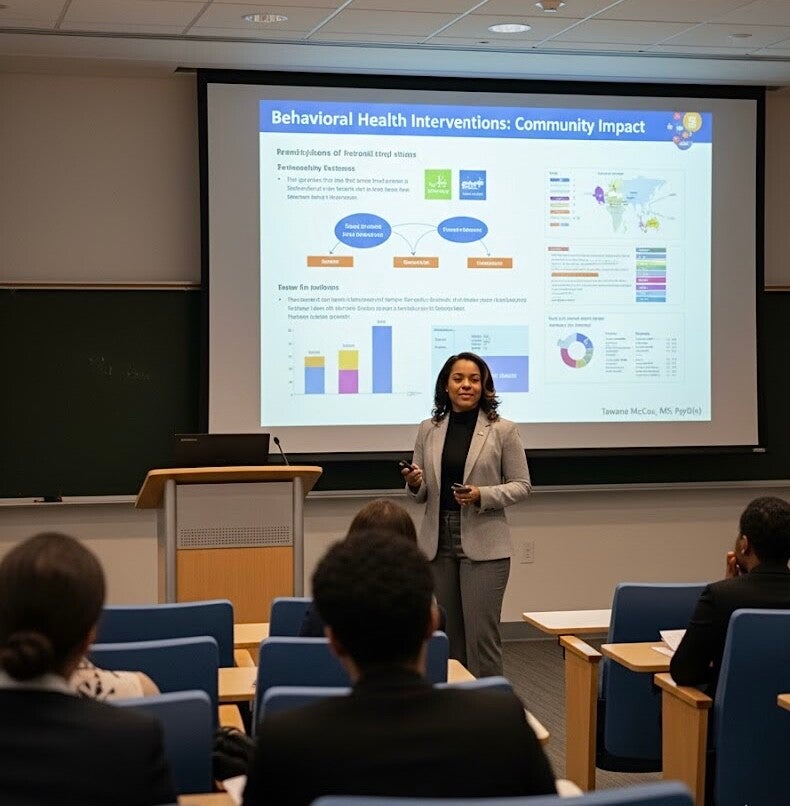
Deep roots in behavioral science & specialized insights
Dr. McCou’s extensive academic background provides a robust foundation for her expertise: currently completing a Doctor of Psychology (PsyD) in Behavioral Health Leadership, holding a Master of Science (MS) in Psychology (Health Psychology) from Walden University, and advanced graduate studies in Epidemiology & Biostatistics from Johns Hopkins Bloomberg School of Public Health. Her learning also includes advanced studies in Organizational Psychology and a Bachelor of Science (BS) in Health Management with a minor in Nursing, complemented by an Associate of Arts (AA) in Business Management. This diverse academic journey underpins her advanced understanding of health behavior, systems leadership, population health, and organizational performance.
Specialized insights and practical tools
🧠
Dr. McCou’s expertise is fortified by a rich set of specializations and certifications. She utilizes Applied Behavioral & Cognitive Modalities including Cognitive Behavioral frameworks (CBT), Rational Emotive Behavioral frameworks (REBT), Neurolinguistic Programming (NLP), and various behavioral change and performance coaching models. Her leadership and professional credentials include certification in Executive & Advanced Leadership from the National Society of Leadership and Success (NSLS),. Her scientific and applied expertise spans Health Psychology, Psychoneuroimmunology, Occupational & Organizational Psychology, Behavioral Health Systems, and the study of stress physiology and cognitive fatigue.

Comprehensive scope of practice
Dr. McCou’s scope of practice is strictly non-clinical, non-diagnostic, and consultative, focusing on providing actionable insight.
Her services include:
1. Organizational Health & Behavioral Systems Consulting: Conducting organizational stress and burnout analysis, psychological safety and leadership climate reviews, behavioral risk mapping related to turnover and disengagement, and evaluating system-level contributors to behavioral fatigue. She provides advisory support during organizational transition, restructuring, or leadership change.
2. Health Psychology–Informed Leadership Strategy: Applying health psychology principles to address chronic workplace stress, offering leadership consultation focused on coping, resilience, and adaptation, and conducting behavioral adherence analysis related to policies and workflows. She supports organizational recovery following disruption or high-stress events.
3. Neuro-Informed Behavioral & Cognitive Insight (Non-Clinical): Providing secondary, complementary service by analyzing cognitive load and decision-fatigue, offering insight into stress-driven behavior patterns, and functional interpretation of attention, memory strain, and mental fatigue. This results in insight summaries to support leadership awareness, workflow design, and training, without neurological testing, diagnosis, or treatment.
4. Education, Training & Strategic Briefings: Delivering executive and leadership briefings on behavioral health risk, training on stress physiology, cognitive fatigue, and burnout prevention, and providing trauma-informed and psychologically supportive leadership education. She also spearheads workforce sustainability and behavioral health awareness initiatives.
Clear value, defined boundaries & client focus
Dr. McCou bridges the crucial gap between clinical findings, leadership intent, and real-world functioning. Her work is invaluable for individuals and organizations struggling despite appropriate care, effort, or resources. She expertly translates behavioral and cognitive strain into clear, ethical, and actionable insights that significantly improve understanding, engagement, adherence, and performance sustainability.
Dr. McCou works with individual clients navigating chronic illness, cognitive fatigue, adherence challenges, and sustained stress; healthcare-referred clients (when medical stability exists but functional challenges remain); and organizations and leadership teams seeking insight into burnout risk, leadership strain, and system sustainability. Clients are always referred to as clients or participants, never patients.